
Why Mitsubishi Heat Pumps Come at a Premium Price in Massachusetts
Table of Contents
ToggleAI Summary: Why Mitsubishi Heat Pumps Cost More in Massachusetts
Mitsubishi heat pumps typically cost more than other brands in Massachusetts because they are engineered for cold-climate performance, deliver higher efficiency ratings, operate more quietly, and include longer warranties when installed by certified contractors. Mitsubishi’s inverter-driven compressors and Hyper-Heat technology allow the systems to maintain heating capacity in sub-freezing temperatures common in New England, reducing reliance on backup heat and improving year-round comfort.
In Massachusetts, installation costs are also higher due to stricter building codes, older housing stock, electrical upgrades, and the expertise required to properly design and commission these systems. While the upfront price is higher, state incentives such as Mass Save rebates and federal tax credits can significantly reduce out-of-pocket costs, making Mitsubishi heat pumps a strong long-term value for homeowners prioritizing reliability, efficiency, and quiet operation.
Across coffee shops from Worcester to the Boston, the conversation keeps circling back to the same topic: how to tame soaring energy costs from traditional heating cooling systems without sacrificing comfort.
Whether you rely on oil-fired furnaces, aging boilers, or oversized central heating air conditioning equipment, the hunt for more energy-efficient heating cooling solutions feels urgent. Browse any neighborhood forum and you’ll notice Mitsubishi ductless and mini split systems dominating the recommendations. One HVAC review site notes that these Mitsubishi Electric systems rank among the most energy-efficient and whisper-quiet heat pumps available thanks to their advanced inverter compressors, durable components, and smart features that boost indoor air quality.
In our recent breakdown of Massachusetts heat pump pricing, we explain that a complete system can run anywhere from $7,000 to $20,000 or more, depending on home layout, system type, and installation complexity. That price tag naturally raises the question: why do Mitsubishi heat pumps often land at the top end of that spectrum, and are they really worth it? This guide unpacks the “why” behind the numbers so you can decide if a premium Mitsubishi mini split or split heat pump is the right choice for your Massachusetts home.
Understanding the True Cost of Mitsubishi Heat Pumps in Massachusetts
Before looking at the bells and whistles, it helps to pin down what “premium” really means in dollars and cents. Our team at Endless Energy recently updated the Massachusetts heat pump cost breakdown, and we’ve found that total project pricing can vary widely based on system type, home size, electrical upgrades, and the number of indoor units. Even so, Mitsubishi heat pump systems routinely sit at the higher end of those ranges, so it is important to unpack why.
Massachusetts homeowners also face a few cost drivers that folks in milder, lower-cost regions simply don’t. As Air Conditioner Lab points out, “States on the North East and West Coast … have higher living costs,” and that translates into pricier equipment, labor, and permitting in places like the Bay State. Add in our freeze-thaw winters and humid summers, and it’s clear why a system engineered for demanding conditions commands a higher ticket. Even the choice of outdoor unit pads, snow stands, and electrical rough-ins has to meet stricter codes here, nudging the final invoice upward.
Mitsubishi Heat Pump Pricing Compared to Other Brands
Here’s a snapshot of what you can expect to pay for a Mitsubishi ductless heat pump or ducted installation versus other brands in Massachusetts:
Single-zone ductless mini split (6,000–18,000 BTU)
Installed totals for Mitsubishi typically fall between $6,800 and $14,000. By comparison, other mid-tier brands often land 10–30 percent lower, but with reduced efficiency, fewer indoor air filtration options, and shorter warranties. Pricing aligns closely with the typical costs for Mitsubishi mini-split systems outlined in a national HVAC retailer’s guide.
Multi zone ductless systems (two to three zones)
Expect $11,000–18,000 for Mitsubishi, reflecting added indoor units, longer refrigerant lines, and advanced zoning controls that deliver precise heating cooling to each space. Competing brands frequently start $2,000–3,000 lower but may sacrifice cold-climate performance and reliable heating cooling when temperatures plunge.
Whole-home ducted heat pump swap-outs
Mitsubishi systems sized for full-house heating air conditioning usually range from $16,000 to $26,000 in Massachusetts, where tight basements, steep rooflines, and older electrical panels can add labor and upgrade costs. Standard-efficiency brands average closer to the low-$20,000 mark but often rely on backup resistance heat when temperatures dip, compromising efficient heating cooling.
To see the real bottom line, Massachusetts homeowners need to factor in incentives, rebates, and ongoing savings—not to mention routine heat pump maintenance that keeps every air handler and outdoor unit operating at peak efficiency.
How Massachusetts Heat Pump Incentives and Rebates Offset Premium Pricing
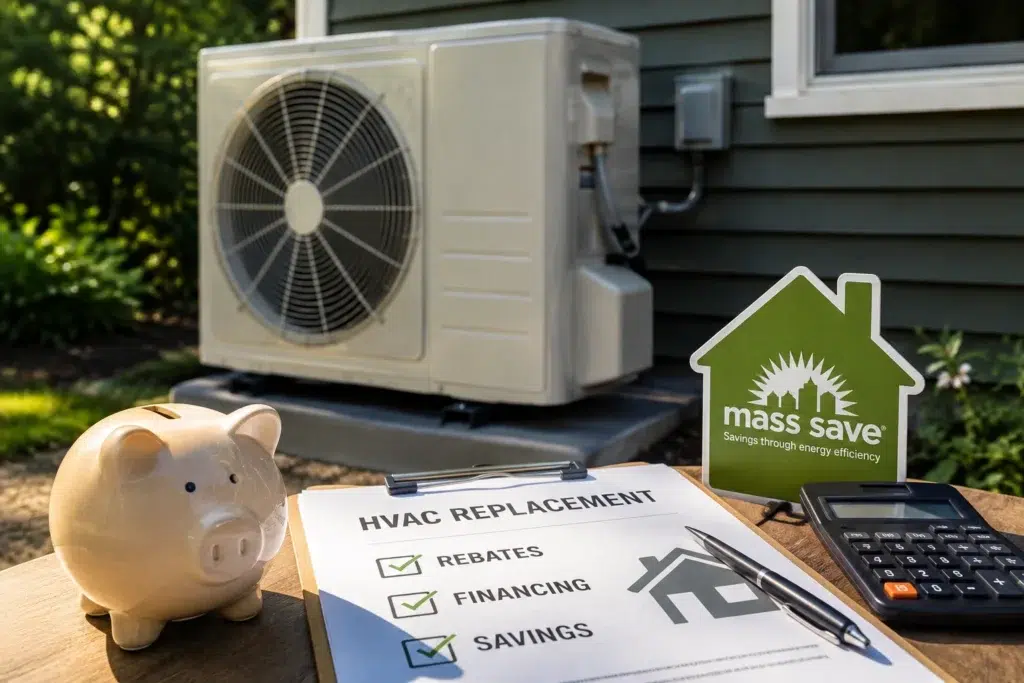
Good news: Bay Staters don’t have to shoulder the entire sticker price alone. Mass Save® rebates remain one of the most robust incentive programs in the country. Our overview shows that qualifying households can currently trim between $1,125 and $8,500 off the initial investment through 2026 Mass Save rebates, with 0 percent HEAT Loans available to spread any remaining balance over several years and soften the impact on monthly budgets.
Digging deeper, the Mass Save Whole-Home pathway sweetens the pot even more. Right now, eligible residents can secure up to a $8,500 whole-home rebate and moderate-income households may qualify for no cost heat pumps when they fully replace oil, propane, or electric resistance equipment with a cold-climate Mitsubishi Electric heat pump like the Hyper-Heat line.
For partial-home or hybrid projects, homeowners can still capture $1,125 per ton up to $8,500, as outlined in the same Mass Save supplemental rebate details. Those dollars go a long way toward narrowing the gap between Mitsubishi and lower-priced brands, especially when paired with the 30 percent federal tax credit that now applies to many energy efficient heat pump systems.
Stacking incentives can yield dramatic results. During a 2025 consultation, our team at Endless Energy helped a Newton homeowner combine a $10,000 Mass Save rebate with a $2,000 federal tax credit, bringing a $21,793 whole-home Mitsubishi project down to just $9,397 out of pocket. As we explained, the move shaved nearly $36 off their 0 percent loan payment and $3,000 would have been lost had they waited until next year, as described in our case study on stacking rebates and tax credits.
With a clearer view of the dollars, both spent and saved, it is helpful to look at the technologies that make Mitsubishi’s premium price tag more than justifiable.
What Makes Mitsubishi Heat Pumps Worth the Investment?
When you look under the hood of a Mitsubishi heat pump mini or full-size system, the first standout is its variable-speed inverter compressor. By continuously adjusting output rather than simply cycling on and off, the technology delivers greater energy efficiency than other brands and holds set temperatures within a degree or two, even when Mother Nature swings from muggy 85-degree afternoons to crisp 50-degree evenings in a single day. That precision helps Massachusetts homeowners cut energy use while enjoying steadier comfort all year long.
As the manufacturer itself notes, Mitsubishi Electric systems post “one of the highest SEER ratings in the industry” and achieve a coefficient of performance approaching 5, meaning they can deliver nearly five units of heat for every unit of electricity consumed, an efficiency milestone that pays off on every utility bill.
Air Conditioner Lab adds that Mitsubishi’s Hyper-Heat line is engineered for places just like New England. Their review explains that select models retain 100 percent of heating capacity at 5 °F and keep producing heat down to –13 °F, thanks to enhanced compressors and refrigerant flow controls, an advantage that ensures reliable warmth long after many standard electric heat pumps flip to costly resistance backup. This is a game changer for homeowners who have experienced the limitations of traditional heating cooling equipment during a polar vortex.
Beyond raw heating and cooling power, Mitsubishi packs a wealth of refinements into each indoor unit that elevate day-to-day living and healthy indoor air:
- i-See Sensor technology scans the room and fine-tunes airflow toward occupied zones for even temperature control in single or multi zone configurations.
- EcoCore inverter drives sip energy, trimming utility costs while supporting quiet, low-RPM operation that rivals library conditions for noise.
- Dual-barrier coatings on heat-exchange surfaces resist dust and oil buildup, helping maintain efficiency, prolong component life, and boost indoor air quality.
- Whisper-quiet fan designs keep sound levels as low as 30–50 dB, so your ductless heat solution won’t drown out conversations or TV time.
- Built-in Wi-Fi, occupancy scheduling, and voice-assistant compatibility put temperature control, air conditioning, and heating cooling modes at your fingertips via the Mitsubishi Electric Kumo Cloud app.
- Designer Series cassettes, slim wall mounts, and concealed-ceiling options ensure that each indoor unit complements your décor far better than bulky legacy air handlers.
Taken together, Mitsubishi’s engineering edge, cold-climate resilience, and refined user features help explain why the brand commands a higher upfront investment. The next step is to see how all that innovation stacks up against other leading heat pumps ductless and ducted manufacturers on the market.
Mitsubishi vs. Other Heat Pump Brands
Massachusetts homeowners weighing their options often ask how Mitsubishi stacks up against other respected names like Daikin, LG, Bryant, and Bosch. Mitsubishi routinely tops the charts for efficiency, noise control, warranty length, and cold-weather reliability, attributes that translate into everyday comfort and long-term savings on energy costs.
Industry reviews highlight that Mitsubishi models deliver seasonal efficiency ratings in the 20–26 SEER range, operate in the 41–50 decibel band, and often last 20 years or more, figures that outclass many rivals while naturally pushing overall cost into the higher bracket, as outlined in this performance summary. Within the same comparison, lower-priced brands posted shorter 5- to 10-year life expectancies and noticeably louder operation, underscoring the trade-offs that come with a smaller price tag.
Independent contractors echo those findings. GreenSavers’ side-by-side table shows Mitsubishi leading peers in critical categories, posting the quietest indoor noise level at just 34 dB, the highest heating efficiency at 12.5 HSPF, and the longest 12-year parts warranty, while clearly listing the brand in the highest price tier. These data points confirm that Mitsubishi’s premium buys elite performance, extended coverage, and peace of mind compared with competitors that score lower or charge extra for similar perks, as shown in their comparison highlights.
Initial dollars, though, are only half the equation. Thanks to inverter-driven compressors that dial energy use precisely to your home’s heating and cooling load, Mitsubishi heat pump ductless and ducted systems can slash monthly utility costs by an estimated 20–40 percent and operate efficiently for 15–20 years, delivering a payback that compounds over decades while sparing you frequent repair bills, according to national cost analyses.
Considering both the tangible and intangible returns—quiet comfort, year-round reliability, and lower lifetime ownership costs—many Massachusetts families decide the higher purchase price is a smart trade for lasting performance. Even the best equipment can underperform, however, if it isn’t installed and supported by true experts. That is where the next piece of the value puzzle comes in.
Why Installation Expertise and Diamond Status Matter in Massachusetts
Even the smartest heat pump systems can stumble if they’re not matched to your home and climate. Our data show that the difference between a smooth-running system and one that struggles through its first winter often comes down to professional design, meticulous commissioning, and proactive heat pump maintenance. Properly sizing equipment, upgrading electrical service, and tackling tricky ductwork can add several thousand dollars to a project, yet those extras protect homeowners from the far steeper costs of premature failures and comfort complaints, a reality we outline in our heat pump installation cost guide.
Massachusetts compounds those challenges. From tight urban lots that limit outdoor unit placement to 200-year-old timber frames that hide surprises behind every wall, local homes demand precise load calculations, thoughtful refrigerant routing, and weatherproof line-set design. That’s why, here at Endless Energy, we lean on factory training, rigorous commissioning checklists, and specialized tools to dial in performance before the first Nor’easter blows through.
In our own deep dive on the subject, we explain that Mitsubishi created its Mitsubishi Diamond Elite program for contractors who can meet “advanced training, ongoing education, and performance standards most can’t handle” while regularly installing and servicing these sophisticated systems—a clear sign that experience isn’t optional when peak efficiency is on the line. As a Diamond Elite Contractor, Endless Energy not only meets those requirements but also brings unmatched local insight from installing heat pumps ductless and ducted across 160-plus Massachusetts communities.
Beyond know-how, elite credentials pay off in hard-dollar terms. Our Diamond Elite status unlocks 12-year parts warranties—far longer than the five- to seven-year coverage typical of standard installations—because Mitsubishi Electric “is willing to bet their own money that Diamond Elite installations last longer and perform better.” Fewer out-of-pocket repairs mean your investment stays predictable for more than a decade.
We’ve seen the payoff firsthand over thirteen years of cold-climate heating cooling work. As we like to remind customers, spending “$2,000 more on a great installation can easily save you $10,000 over the life of your system,” since properly charged, well-sited equipment avoids the efficiency losses and emergency service calls that plague corner-cut installs. That is true whether you choose a compact heat pump mini for a single room, a multi zone ductless heat pump for an addition, or a whole-home split heat pump matched to existing ductwork.
Choosing the right partner, then, is the final piece of the value puzzle.
Unlocking the Full Value of Mitsubishi Heat Pumps for Your Massachusetts Home
In our own assessment of Mitsubishi as the region’s premium option, we put it plainly: “Their Hyper-Heat technology is legit… Mitsubishi’s hard to beat when winter lows hit negative numbers,” a sentiment shared in our gold-standard overview. Pair that cold-climate muscle with ultra-quiet operation, best-in-class efficiency, enhanced air quality features, and up to 12 years of parts coverage, and it’s clear why paying a little more up front often means paying far less in stress, service calls, and utility bills over the next two decades. For homeowners who value reliable heating cooling and healthier indoor air, the upgrade is tough to beat.
Ready to see how a Mitsubishi ductless or ducted system could revolutionize comfort and savings in your own home? Book a free heat pump assessment with Endless Energy today, and let our Diamond Elite Contractor team design a solution that maximizes rebates, tax credits, and long-term peace of mind.
Ready to see if a Mitsubishi heat pump makes sense for your home?
Schedule a free heat pump assessment with Endless Energy by calling us at 508-501-9990 or self-schedule a free heat pump consultation. Endless Energy’s Heat Pump Designers team will design a system that maximizes rebates, minimizes operating costs, and delivers reliable comfort through every Massachusetts winter.
FAQs: Mitsubishi Heat Pump Pricing in Massachusetts
Why are Mitsubishi heat pumps more expensive than other brands?
Mitsubishi heat pumps cost more because they offer superior cold-climate performance, higher efficiency ratings, quieter operation, longer warranties, and stricter installation requirements than many competitors.
Are Mitsubishi heat pumps worth the extra cost in Massachusetts?
For many Massachusetts homeowners, yes. Mitsubishi systems are designed to maintain heating output in sub-freezing temperatures, reduce energy use, and last longer, making them a strong long-term investment.
Do Mitsubishi heat pumps qualify for Mass Save rebates?
Yes. Many Mitsubishi systems qualify for both Mass Save Whole-Home and Partial-Home Mass Save rebates, which can reduce the upfront cost by thousands of dollars.
Is installation more expensive for Mitsubishi heat pumps?
Often, yes. Mitsubishi systems require precise design, electrical upgrades, and commissioning. Higher installation quality helps protect efficiency, comfort, and warranty coverage.
What is a Mitsubishi Diamond Elite Contractor?
A Diamond Elite Contractor is factory-trained, vetted by Mitsubishi Electric, and authorized to offer extended warranties, including up to 12 years of parts coverage.