
We’ve Installed Dozens of Heat Pump Water Heaters. Here’s Why We Keep Coming Back to the Rheem ProTerra
Installer verdict: The Rheem ProTerra is one of the best heat pump water heaters for Massachusetts homes because it works in cool basements, qualifies for strong Mass Save rebates, and uses hybrid operation to prevent hot water shortages.
“So which one would you put in your own house?”
That’s the question we get about heat pump water heaters at least twice a week. And honestly? Nine times out of ten, our answer is the Rheem ProTerra.
Not because Rheem sponsors us (they don’t). Not because it’s the cheapest option (it’s not). But because after installing and servicing these things in Massachusetts basements for years, the ProTerra is the one we’d feel comfortable putting in our own homes—and that’s the standard we use for our customers.
Here’s what actually matters when you’re choosing a heat pump water heater, and why the ProTerra consistently gets it right.
It Doesn’t Need Perfect Conditions to Work Well
Massachusetts basements are… let’s call them “character-filled.” They’re often 55-60°F in winter, sometimes damp, occasionally musty, and rarely finished with drywall and carpet.
Heat pump water heaters work by extracting heat from the air around them—which means they need to handle real basement conditions, not just laboratory testing environments. According to the Department of Energy, heat pump water heaters work best in spaces that maintain temperatures between 40°F and 90°F year-round. Massachusetts basements usually fall right in that range, but barely.
The ProTerra handles this without complaint. It pulls heat efficiently even when your basement is cool, and as a bonus, it actually dehumidifies the air as it runs. We’ve had homeowners tell us their basement feels noticeably drier after installation—especially during humid summers.
For older New England homes where “ideal installation conditions” is a fantasy, that real-world flexibility matters more than any spec sheet can capture.
The Hybrid Mode Actually Solves the “Will I Run Out of Hot Water?” Problem
This is the number one concern people have about heat pump water heaters: recovery time.
Translation: “What happens when my teenager takes a 20-minute shower right before I need to do laundry and run the dishwasher?”
Heat pump water heaters heat water more slowly than traditional electric resistance tanks—that’s just physics. But the ProTerra handles this with true hybrid operation that actually works intelligently.
Most of the time, it runs in heat pump mode for maximum efficiency (this is where you get the energy savings). When hot water demand spikes beyond what the heat pump can handle, it automatically kicks in electric resistance elements to keep up.
You don’t set this manually. You don’t change modes. You don’t even think about it. The system monitors usage patterns and responds.
According to ENERGY STAR, hybrid heat pump water heaters like the ProTerra can save a typical family of four about $550 per year on water heating costs compared to standard electric models—without sacrificing performance during high-demand periods.
That’s the kind of hands-off reliability we want for our customers.
It’s Built to Maximize Massachusetts Rebates
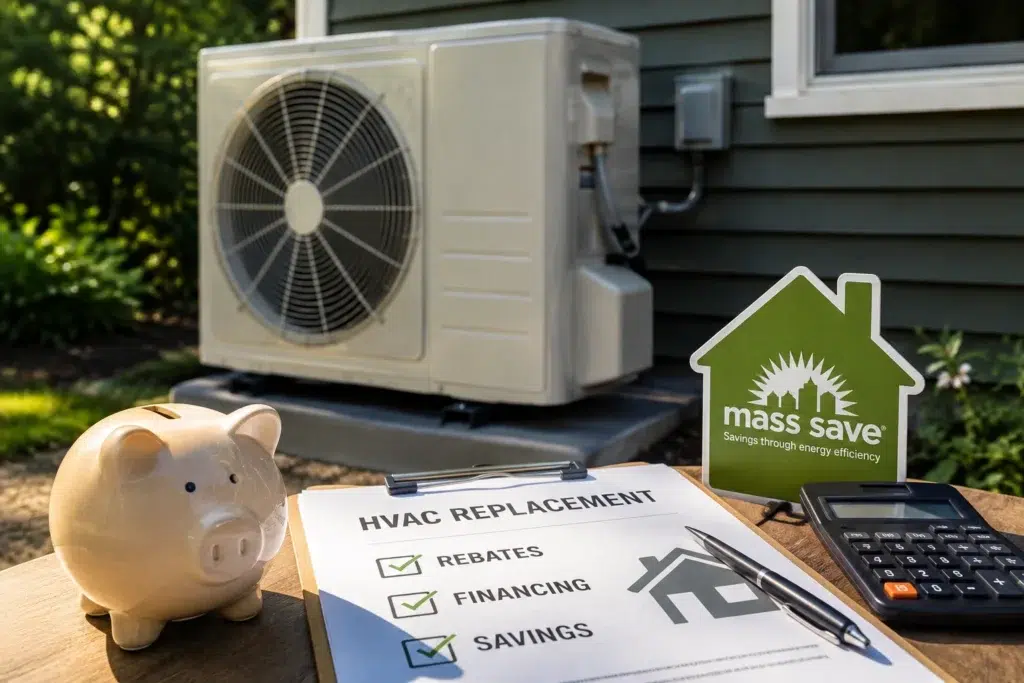
Massachusetts has some of the strongest incentives in the country for heat pump water heaters. Through Mass Save and utility programs, eligible homeowners can get rebates of $750-$1,500+ depending on income and project scope.
The ProTerra is specifically designed to meet and exceed the efficiency requirements for these programs. It carries an ENERGY STAR certification and typically qualifies for the maximum available rebates without jumping through hoops.
Just as important: Rheem has been manufacturing water heaters since 1925. Parts availability is strong. Warranty support is responsive. Technicians know these units. When you’re installing equipment you expect to rely on for 10-15 years, that kind of manufacturer stability matters.
We’ve seen trendy brands come and go. Rheem isn’t going anywhere.
The “Smart” Features Are Actually Useful (Not Gimmicky)
Some smart appliances feel like they have Wi-Fi just to justify a higher price tag. The ProTerra’s connected features are actually practical.
Through the Rheem EcoNet app, you can:
- Monitor real-time energy use – See exactly how much your water heating costs
- Change operating modes remotely – Switch to vacation mode from your phone
- Get leak detection alerts – The unit will notify you if it detects water where it shouldn’t be
- Track hot water availability – Know if you have enough hot water for a shower before you start
For most families, this is the first time they can clearly see their hot water energy consumption. That visibility alone leads to better decisions without sacrificing comfort.
We’ve had customers text us screenshots from the app showing their monthly savings. That kind of engagement doesn’t happen with a traditional tank heater.
It’s Quiet and Actually Improves Your Basement
One concern people have about heat pump water heaters is noise. Yes, they have a compressor and fan, so they’re not completely silent. But the ProTerra runs noticeably quieter than older models or cheaper alternatives.
Most homeowners describe it as a low hum—similar to a refrigerator running upstairs. If your mechanical room is in the basement and you sleep on the second floor, you won’t hear it.
The dehumidification benefit is subtler but real. By pulling moisture out of the air during operation, the ProTerra can actually make your basement feel less damp. During humid Massachusetts summers, that’s a legitimate quality-of-life improvement—especially if you have finished space or storage downstairs.
Why We Keep Installing These (Even When Other Options Exist)
At Endless Energy, we’re selective about the equipment we recommend. We look at:
- Performance in real homes (not just lab tests)
- Long-term reliability (we service what we install)
- Manufacturer support (can we get parts in two weeks?)
- Customer satisfaction (do people actually like living with it?)
The Rheem ProTerra consistently delivers on all four:
✓ Reliable hot water for real household demand patterns
✓ Strong rebate eligibility in Massachusetts programs
✓ Smart features that people actually use
✓ Proven manufacturing with responsive support
That combination makes it one of the easiest recommendations we make. Not the only option—we install other brands when it makes sense—but the one we default to when we want a safe bet.
Is a Heat Pump Water Heater Right for Your Home?
If your current water heater is 8+ years old, struggling to keep up, or just costing too much to run, a heat pump water heater might be your best next move.
The ProTerra works especially well if you:
- Have a basement or utility room with moderate temperatures year-round
- Want to maximize Massachusetts rebates and incentives
- Prefer equipment that handles itself without constant adjustments
- Care about long-term operating costs, not just upfront price
Not every home is a perfect fit—some spaces are too small, too cold, or configured in ways that make installation tricky. But for the majority of Massachusetts homes we work with, the ProTerra is an excellent choice.
We’re always happy to walk through rebate options, sizing, and whether your specific home is a good candidate. No pressure, no sales pitch—just straight answers from people who’ve installed these dozens of times.
Endless Energy 508-590-9257
Self-Schedule: goendlessenergy.com
Quick Comparison: Rheem ProTerra vs. Traditional Electric Water Heater
| Factor | Traditional Electric Tank | Rheem ProTerra HPWH |
|---|---|---|
| Annual Operating Cost | ~$600/year | ~$250/year |
| Recovery Time | Fast (high power draw) | Slower, but hybrid mode compensates |
| Basement Impact | Neutral | Dehumidifies air |
| Massachusetts Rebates | $0-$100 | $750-$1,500+ |
| Noise Level | Silent | Low hum (quieter than older HPWHs) |
| Smart Features | None | Remote monitoring, leak detection, scheduling |
| Lifespan | 10-12 years | 10-15 years |
Cost estimates based on average Massachusetts electricity rates and typical family of four usage patterns