
Best Heat Pump Thermostat Settings for Massachusetts Winters: Comfort, Efficiency, and Expert Tips
Is your heat pump’s thermostat really dialed in for the deep-freeze days ahead, or could a few quick tweaks unlock new levels of comfort and savings? Whether you’re looking to streamline your heating and cooling strategy, trim energy costs, or simply feel warmer on those single-digit nights, the right temperature settings can make all the difference.
Here in Massachusetts, where heating and cooling costs can climb as quickly as the snow drifts, the way you set your thermostat matters just as much as the equipment you choose. Heat pumps already offer a major advantage: they warm your home in the winter, cool it in the summer, and trim greenhouse-gas emissions, all while qualifying for generous rebates and 0% financing through Mass Save’s HEAT Loan, one of the many efficient heating and cooling incentives available through the program for eligible customers. By understanding how modern heat pump systems thrive in Massachusetts’ challenging climate and adopting smart thermostat temperature practices, you’ll keep rooms cozy, reduce energy waste, and extend the life of your investment — a win-win for comfort energy and your wallet.
Table of Contents
ToggleUnderstanding How Heat Pumps Work in Massachusetts Winters
Modern cold-climate heat pumps are built for New England’s frigid winters. Instead of burning fuel like a furnace or traditional boiler, they use electricity to move existing outdoor heat indoors via an ultra-efficient refrigerant cycle and inverter-driven compressors. As outside temperatures fall, these systems automatically ramp up compressor speed to maintain reliable heating output without the dry air or combustion by-products that older boilers and furnaces create.
Mass Save notes that today’s air-source and ground-source units can efficiently heat in winter while doubling as whole-home cooling systems in summer, all without on-site fossil-fuel storage or direct carbon emissions. That high performance, paired with Massachusetts’ clean electricity mix, translates to lower utility bills and a lighter environmental footprint rooted in true energy efficiency.
Cold-Climate Efficiency Explained
Cold-climate models deliver impressive results even when the mercury plummets. Consider how they stack up against familiar heating options:
- EnergySense at the University of Illinois reports that standard air-source equipment can transfer about 3 times, or 300 %, of the energy they consume, and the best cold-climate versions can approach 400 % efficiency — potentially outperforming high-efficiency gas furnaces, which top out around 92 % (transfer 3x the energy they consume). That’s serious energy savings in both heating cooling modes.
- Inverter-driven compressors vary their speed to match the home’s load. By avoiding energy-wasting start-and-stop cycles, they maintain a high coefficient of performance (COP) and steady indoor comfort — even at outdoor temperatures near, and sometimes below, –15 °F (degrees Fahrenheit).
- Because heat pumps provide both heating and cooling, you gain year-round value from one piece of equipment, simplifying maintenance and freeing up basement or attic space once claimed by a separate furnace or central air handler.
Dispelling Common Heat Pump Myths
Despite these advances, a few persistent myths still circulate among Massachusetts homeowners:
- You must keep a backup furnace or boiler running once temperatures tumble.
- Heat pumps struggle below freezing and can’t keep up with Nor’easters.
- Efficiency drops so sharply in cold weather that energy bills skyrocket.
Real-world data and field experience prove otherwise. TRC Companies notes that with proper system sizing, placement, and installation, heat pumps can cover the entire heating load of almost any building in the contiguous 48 states and still deliver roughly 200 % efficiency at 5 °F — even operating down to about –20 °F — while matching or beating dual-fuel setups on performance and cost-effectiveness (cover the entire heating load).
Taken together, the evidence is clear: today’s cold-climate heat pumps are fully capable of handling Massachusetts’ chilliest nights. That means your next big opportunity isn’t worrying about whether the equipment can perform — it’s deciding how to set the thermostat for maximum comfort and minimal energy use throughout the fall winter season.
Setting Your Heat Pump Thermostat: Comfort Meets Efficiency
Switching from a furnace to a heat pump changes more than just your equipment — it changes the smartest way to handle switching heating cooling and to program a programmable thermostat. Traditional boilers and furnaces cycle on and off, so homeowners often lower temperatures at night or when leaving the house. Heat pumps excel when they maintain a steady temperature set point, adjusting output smoothly rather than starting from scratch each time. That “set-and-forget” or set forget approach preserves both comfort and efficiency, turning your thermostat into a powerful ally against high heating cooling costs.
Finding Your Comfort Number
Think of your thermostat setting as a personal comfort number, not a strict target on the dial. Because mini-split sensors sit higher on the wall — where air is naturally warmer — you may need to dial in a few extra degrees Fahrenheit compared with your old system to feel the same warmth at sofa level. Mass Save reminds homeowners that you may need to bump up the temperature setting on the remote a little higher than you would on a normal thermostat, an easy adjustment that keeps rooms consistently cozy while letting the heat pump handle the heavy lifting “bump up the temperature setting”.
To locate your ideal point, start at your typical winter temperature set thermostat — say 68 °F — then raise or lower it by one degree each day until everyone feels comfortable. Give the system at least 24 hours at each setting; the heat pump’s gradual modulation means benefits show up over time, not in minutes. Once you land on the magic number, jot it down, share it with the household, and resist the urge to be constantly adjusting the controls just for the sake of experimentation.
Why “Set It and Forget It” Works Best
Eversource notes that constantly fiddling with a heat pump’s controls can backfire, warning that frequent changes may actually use more energy and cause comfort issues and advising residents to find a temperature that’s comfortable and leave it there, because your system is designed for steady, energy efficient heating and cooling.
Here’s why locking in that number pays off:
- Consistent temperatures reduce the energy spikes caused by repeated ramp-ups, trimming monthly bills and helping you save money on both heating cooling costs.
- A steady indoor climate prevents hot-and-cold swings, fostering stable comfort energy and a more even, draft-free feeling throughout your living spaces.
- Maintaining a stable load places less stress on compressors and fans, extending equipment life, supporting long-term energy efficiency, and protecting your investment.
- Avoiding wide temperature settings swings keeps relative humidity in check, supporting healthier indoor air quality during dry winter months.
- If you use smart thermostats or a programmable thermostat, a fixed set thermostat schedule simplifies your morning routine and ensures remote monitoring is accurate, whether you’re home for the holidays or traveling.
With your comfort number chosen and your thermostat set on cruise control, you’re ready to refine advanced cooling modes and fan settings — as well as strategies for switch heating cooling — to capture every last kilowatt of savings.
Expert Tips for Optimizing Comfort and Savings
Fine-tuning a heat pump is a bit like adjusting a high-performance vehicle — small changes make a big difference in mileage, responsiveness, and overall comfort. Use the strategies below to keep energy costs in check while ensuring every room feels just right.
Fine-Tuning Fan and Mode Settings
Your remote offers more options than simply “up” or “down.” Understanding each heating cooling mode helps the system deliver stable temperatures and healthy indoor air quality all winter long.
• Choose HEAT, skip AUTO: In winter, select the dedicated HEAT mode instead of AUTO. AUTO can cause the unit to toggle between heating and cooling on milder days, wasting energy and creating drafts. Setting the specific mode keeps the compressor focused on producing warm air efficiently and eliminates unnecessary switching heating cooling cycles.
• Let AUTO FAN do the thinking: While temperature mode should be fixed, feel free to use AUTO FAN. The fan will adjust its speed to maintain even comfort, saving electricity without sacrificing warmth.
• Dial in the right fan speed:
- Low: Quiet operation but slower warmth distribution — best for bedrooms at night or during fall winter shoulder seasons.
- Medium: Balanced airflow for most living spaces, supporting steady comfort energy savings.
- High: Fast heat-up when you’ve just come in from shovelling snow, though it can add a touch more noise.
- AUTO FAN: Lets the system modulate for you, blending performance and energy savings without constant oversight.
Coordinating with Backup Systems
Many Massachusetts homes keep a boiler or furnace as a safety net. To prevent two systems from fighting each other — and inflating utility bills — follow this simple sequence:
- Set your heat pump temperature: Program or set thermostat degrees to your comfort number and leave it in HEAT mode.
- Set degrees on the boiler or furnace lower: Drop the backup system’s thermostat temperature by at least 10 °F so it fires only in rare, extreme cold snaps.
- Install integrated controls: These smart devices automate the switch heating cooling hierarchy, ensuring the heat pump runs first and the boiler engages only when truly necessary, adding a layer of energy efficient heating logic.
- Close dampers or radiators in zones served by heat pumps so your backup system isn’t reheating already-warm rooms, an easy step that can further reduce energy use.
Maintenance and Seasonal Checklist
A well-tuned heat pump is an efficient heat pump. Keep yours humming with this quick winter checklist and enjoy ongoing comfort energy savings:
• Clean or replace indoor filters monthly — clogged filters restrict airflow, forcing the compressor to work harder and driving up energy costs.
• Clear snow, ice, and leaves from the outdoor unit to maintain proper airflow and prevent defrost issues; this is especially critical during heavy fall winter storms.
• Inspect refrigerant lines and insulation for wear; tight seals keep every British thermal unit where it belongs, boosting energy efficient heating.
• Schedule professional service at least once a year (twice is better — spring and fall) to verify refrigerant charge, test defrost controls, and confirm electrical connections.
Neglected maintenance can slash efficiency, erode comfort, and jeopardize manufacturer warranties. A few minutes with a garden hose, a soft brush, or a filter vacuum now can save hours of costly repairs later and protect hard-won energy savings.
Unlocking Extra Savings: Mass Save® Rebates and Endless Energy Expertise
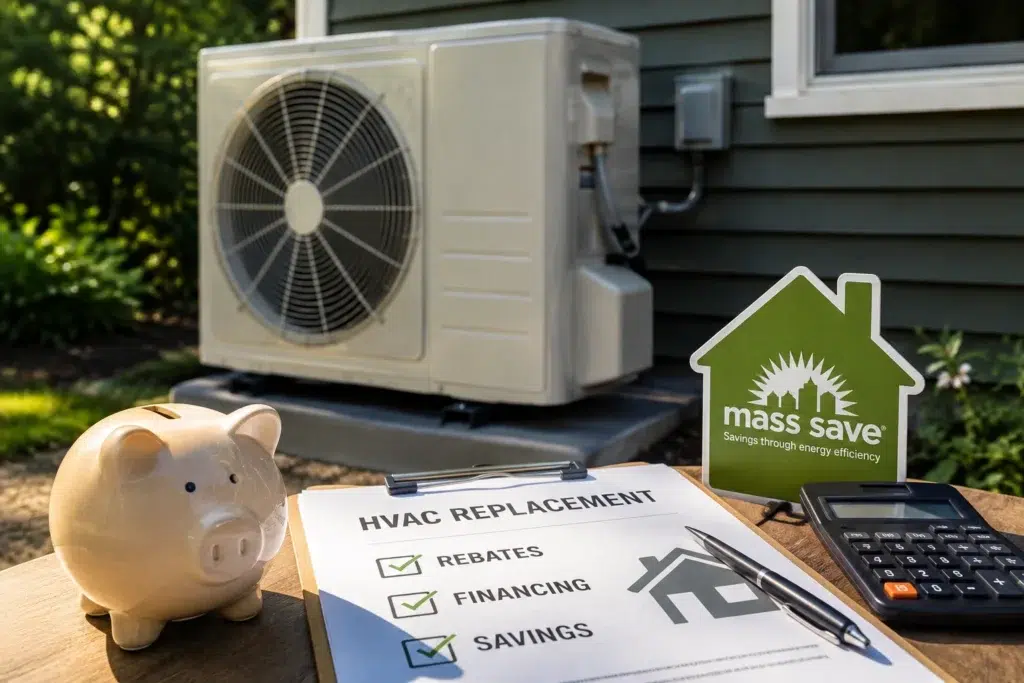
Massachusetts doesn’t just reward efficient thermostat habits; it also puts serious cash back in homeowners’ pockets when they upgrade to high-performance heat pumps. The statewide Mass Save program currently offers tiered incentives for air-source systems, with 2025 rebates structured to encourage both full electrification and thoughtful partial-home installs.
Navigating Mass Save® Rebates
Mass Save’s 2025 offerings make it easier than ever to offset upfront costs and accelerate your ROI. Here’s a snapshot of what’s on the table for qualifying heat pump projects:
- Whole-home installations: up to $10,000 (capped at $3,000 per ton)
- Partial-home installations: up to $10,000 (capped at $1,250 per ton)
- Basic upgrades or add-ons: $250 per ton, up to $2,500 — perfect if you’re adding a mini-split to that chilly guest room before the next fall winter season.
- Weatherization bonus: $500 for completing recommended insulation or air-sealing within the program timeline, further boosting energy efficiency.
- Sizing bonus: $500 when your contractor designs the system to meet total heating load efficiently — a hidden gem for additional energy savings.
- Income-based enhanced incentives: up to $16,000 for qualifying households, making energy efficient heating more accessible to everyone.
These figures come from Mass Save’s detailed outline of 2025 air-source heat pump rebates, which also notes that incentive levels will decline in 2026 — one more reason to act soon if you want to save money.
Pair those rebates with the current federal 25C Energy Efficient Home Improvement Credit, which can cover 30 % of the remaining project cost (up to $2,000 annually for heat pumps and $600 for related panel upgrades). When combined, these incentives can slash thousands from your out-of-pocket expenses, leaving more room in your budget for future upgrades, like adding solar panels to create an all-electric, low-carbon home.
Beyond the dollar amounts, Mass Save sets clear eligibility guardrails to ensure quality results. Qualified systems must carry the ENERGY STAR Cold Climate badge, be installed by a contractor in the program’s Heat Pump Installer Network, and — if you’re pursuing a whole-home rebate — follow weatherization guidelines that keep heating loads manageable. Meeting these requirements not only unlocks funding but also guarantees long-term comfort energy and efficiency.
How Endless Energy Makes It Easy
Here at Endless Energy, we’ve helped Massachusetts families navigate these incentives and maximize savings for more than 40 years. As a certified Mass Save Home Performance Contractor and Mitsubishi Elite Diamond Contractor, our in-house team:
- Conducts no-cost Home Energy Assessments to verify weatherization needs and rebate eligibility, helping you set thermostat degrees and select optimal temperature settings for every room.
- Designs right-sized, cold-climate heat pump systems that meet program standards, deliver superior energy efficient heating, and accommodate seamless switch heating cooling functionality.
- Handles all Mass Save paperwork, rebate submissions, and coordination of 0 % HEAT Loan financing so you don’t have to — an effortless path to immediate energy savings.
- Provides extended warranties, priority maintenance scheduling, and transparent pricing — no surprise fees, ever.
- Optimizes your setting heat pump strategy, walks you through programmable thermostat features such as vacation cooling modes for summer, and offers seasonal tune-ups to keep your system running at peak efficiency year after year.
Ready to lock in cozy rooms, lower bills, and stress-free savings? Contact Endless Energy today, and let our team fine-tune your heat pump, secure every available incentive, and help make this winter your most comfortable — and affordable — one yet.