
Heat Pumps vs. Furnaces in 2025: Which Heating Solution Is Winning in Massachusetts?
“Americans bought 32% more than the next-most-popular heating appliance, gas furnaces, last year,” according to Canary Media. That record-setting gap in 2024 signals a seismic shift in how households across the country – and right here in Massachusetts – are choosing to stay warm.
For Bay State homeowners, selecting the right system isn’t just a line item on a renovation checklist. The decision reverberates through monthly utility bills, long-term maintenance costs and even your home’s carbon footprint. And with heat pumps having outsold gas furnaces since 2021, per RMI’s market analysis, it’s clear that efficiency, versatility and sustainability are reshaping what “comfortable” means in 2025.
Table of Contents
ToggleDecoding the Data: Are Heat Pumps Outselling Furnaces in 2025?
The numbers tell a compelling story. Market tracking from RMI’s data-driven analysis shows that heat pumps have topped gas furnaces every year since 2021, shipping 4.1 million units in 2024 – about 32 percent more than the 3.1 million natural gas furnaces that left factory floors. Early 2025 figures keep the momentum going, with heat pump shipments still outpacing furnaces by roughly 25 percent.
That steady rise is reshaping expectations nationwide. As shipments climb, overall HVAC demand is rebounding from a brief 2023 dip, signaling that homeowners are embracing efficient, all-electric comfort rather than defaulting to traditional fuel-burning equipment.
Industry observers have taken note. As Canary Media reports, heat pumps “outsold gas furnaces in 2024 – and by a bigger margin than ever,” a leap that shattered the previous year’s record lead and underscored a “long-term, consistent trend” toward cleaner heating solutions.
Still, shipment data isn’t a perfect proxy for what’s actually installed. A single furnace often heats an entire New England home, while a whole-home heat pump setup may use multiple outdoor units, making one-for-one comparisons tricky. Shipments do, however, reveal where manufacturers – and increasingly contractors – see demand heading.
A closer look at annual tallies reinforces the trajectory. NYSERDA notes that “Americans bought 3,616,632 heat pumps in 2023, compared to 2,989,516 gas furnaces,” a gap that widened from the year before and set the stage for 2024’s record-setting surge.
With the trend line clear, the next question is why: What’s driving Massachusetts residents – long loyal to oil and gas – to consider electric heat pumps in growing numbers?
The Massachusetts Landscape: What’s Fueling Local Heating Choices?
Massachusetts homes have long leaned on oil and natural gas, a legacy that still shows up in statewide statistics. A recent analysis of heating preferences indicates that oil or gas furnaces remain the dominant primary heat source across the Commonwealth, reflecting decades of entrenched fuel infrastructure and homeowner familiarity. Yet that picture is changing quickly as more residents explore electric heat pumps to curb energy costs and shrink their carbon footprints.
Policy is accelerating the pivot. Nine states – including Massachusetts – have pledged to ensure heat pumps account for at least 65 percent of residential HVAC sales by 2030, part of a broader push to install 20 million units nationwide this decade. Those commitments send a clear market signal that incentives, utility programs and code updates will continue steering homeowners toward electric heat pumps over new fossil-fuel systems.
Even in a region known for icy winters, confidence in cold-climate technology is rising. As NYSERDA explains, “Cold-climate air source heat pumps can perform in temperatures as cold as -20 degrees Fahrenheit… In fact, heat pump sales growth is highest in colder regions – both in the U.S. and globally,” citing Maine’s early completion of its 100,000-unit target and Northern Europe’s record adoption rates. That real-world track record resonates with Bay Staters who once assumed electric heat couldn’t handle a Nor’easter.
- So what’s really driving (or slowing) change in Massachusetts? Consider these common motivators and obstacles:
- Rising energy costs: Volatile fossil-fuel prices push homeowners to seek more predictable electric heat pump operating costs
- Climate commitments: State decarbonization goals and municipal climate action plans encourage all-electric upgrades
- Robust incentives: Mass Save® rebates, Federal IRA tax credits and zero-percent HEAT Loan financing lower upfront costs
- Familiarity and trust: Many residents (especially in older homes) are comfortable with the reliability of natural gas or oil furnaces
- Cold-weather performance concerns: Some homeowners still question whether heat pumps can deliver cozy heat on sub-zero nights, despite modern cold-climate models proving otherwise
- Installation logistics: Historic homes with limited ductwork or tight mechanical rooms may require creative design or hybrid solutions
- Long-term savings vs. upfront investment: Evaluating payback periods and resale value can be daunting without expert guidance
These local dynamics set the stage for a head-to-head comparison of what each technology delivers under real Massachusetts conditions – efficiency, comfort, cost and more.
Comparing Heat Pumps and Furnaces: Efficiency, Comfort, and Cost
Before you commit to one technology, it helps to see how today’s heat pumps and furnaces stack up across the factors that matter most. Here’s a side-by-side snapshot:
- Efficiency: Modern heat pumps achieve efficiency levels of up to 300% by moving heat rather than generating it, while new gas furnaces reach 95–98 percent AFUE thanks to 2025 federal standards.
- Upfront cost: Average installed prices land around $6,000–$20,000 for a heat pump versus roughly $2,800–$6,800 for a high-efficiency gas furnace.
- Operating costs: Electric heat pumps typically use less energy in mild weather, though natural gas can be cheaper per BTU during extreme cold – especially if you already have gas service.
- Cooling capability: Heat pumps deliver year-round heating and cooling in one package; furnaces need a separate central AC or window units for summer comfort.
- Sustainability: Because heat pumps run on electricity – and Massachusetts’ grid is getting cleaner every year – they slash on-site fossil fuel use and help cut your home’s carbon footprint.
When winter bites, performance anxiety is understandable. NYSERDA reassures homeowners that “Cold-climate air source heat pumps can perform in temperatures as cold as -20 degrees Fahrenheit… In fact, heat pump sales growth is highest in colder regions – both in the U.S. and globally,” underscoring real-world reliability for New England winters in a discussion of cold-weather performance.
Hybrid thinking offers yet another option. A dual-fuel setup pairs a heat pump with a high-efficiency natural gas furnace. Your heat pump provides ultra-efficient warmth the majority of the heating season, then hands off to the furnace only on the chilliest days. That automatic switchover balances comfort, lowers fuel bills and eases the transition for homeowners who aren’t ready to go fully electric.
Ultimately, whether you lean all in on electric heat or blend technologies, financial incentives can tip the scales.
Unlocking Savings: Rebates, Incentives, and the True Cost of Switching
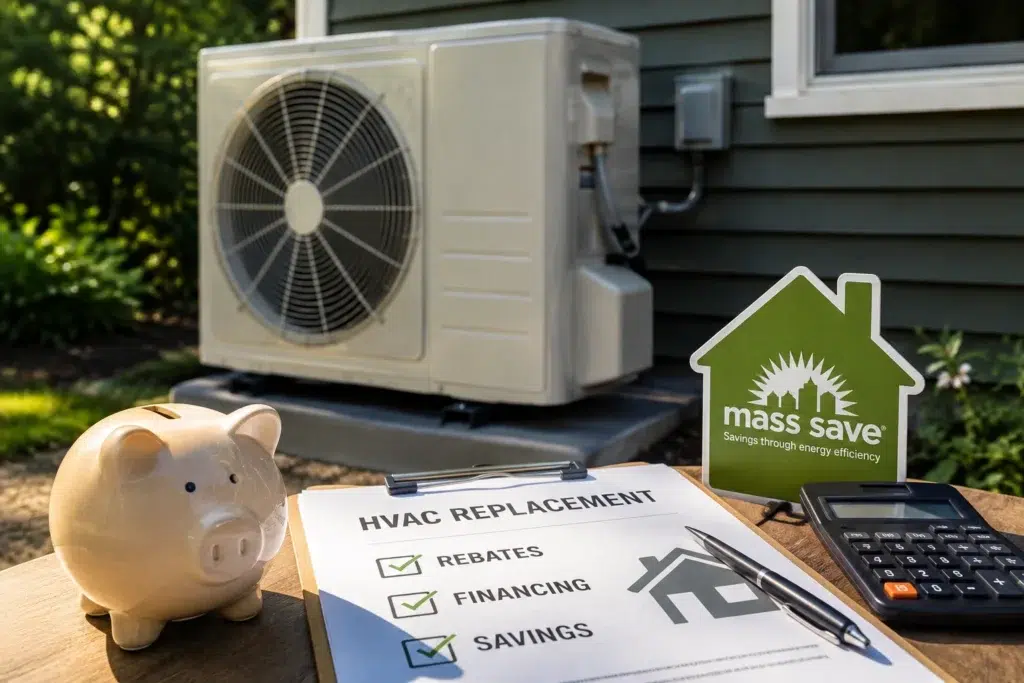
Massachusetts homeowners don’t have to shoulder the entire expense of a new heating system on their own. Federal, state and utility programs now funnel unprecedented dollars into efficient equipment. The Inflation Reduction Act (IRA) offers a federal tax credit of up to 30 percent of project costs (capped at $2,000 annually) for qualifying heat pump installations through 2025, while Mass Save® provides rebates that can reach $8,500 for whole-home air-source systems. Taken together with zero-interest HEAT Loans, these incentives can shave thousands off the price tag and accelerate payback periods.
A clean-energy news outlet notes that multiple Northeastern states have formally pledged that heat pumps will claim at least 65 percent of residential HVAC sales by 2030, a policy push that all but guarantees continued – and possibly expanded – rebate funding in the years ahead.
Take Control of Your Comfort and Savings This Year
Momentum is only building. NYSERDA’s latest market brief notes that heat pump shipments in the first quarter of 2024 were 30% higher than gas furnaces, highlighting that the efficiency, incentive and climate advantages you’ve just read about are resonating with homeowners across the Northeast.
The takeaway is clear: heat pumps are leading the pack, but the “right” choice still hinges on your budget, comfort goals and home’s unique characteristics. That’s where we come in.
Book a free heating consultation with our team at Endless Energy today, and our experts will design a tailored plan – whether that’s a cutting-edge heat pump, a high-efficiency furnace or a hybrid solution, or a hybrid solution – that maximizes rebates, trims energy bills and keeps your Massachusetts home comfortable all year long.