
AC Replacement vs. Repair in Massachusetts: How to Decide Before Summer Hits
It’s 85 degrees outside, the humidity has turned the house into a sauna, and your air conditioner is making a sound it has never made before. A technician shows up, diagnoses the problem, and hands you a quote with two columns: repair or replace.
It’s rarely a simple call, and the stakes run both ways. Over repair a dying system and you’ve spent real money on borrowed time. Replace too early and you’ve walked away from a system that had good years left.
At Endless Energy, we work through this decision with homeowners across Metrowest, North Shore, Boston, and the South Shore every week. Here’s the framework we use, and the one you should run yourself before a hot July afternoon forces your hand.
| Quick answer: If your central AC is under 10 years old and the repair comes in under roughly half the replacement cost, fix it. If it’s 15+ years old, running on R-22 refrigerant, or has needed multiple repairs over the past few summers, start pricing replacement now, before peak season lead times stretch out. |
Table of Contents
ToggleThe Decision Framework at a Glance
None of these factors decide on their own. The stronger the cluster on one side of the table, the clearer the call.
| Factor | Lean Repair | Lean Replace |
| System age | Under 10 years | 15+ years |
| Repair cost vs. new system | Under ~30% | Above 50% |
| Refrigerant type | R-410A or R-454B | R-22 |
| Repair spend, past 3 years | Under $500 total | $1,500+ total |
| Efficiency rating | 14 SEER or higher | Below 13 SEER |
| Comfort complaints | None or minor | Hot spots, humidity, noise |
| Planning to sell in 1 to 2 years | Yes | No |
Start With the Age of the System
Central AC units and standard split systems typically last 15 to 20 years in New England homes, though coastal salt air on the South Shore can knock a couple of years off the top end of that range. A 10 year old system that breaks down is a different conversation than a 17 year old one. Age alone doesn’t decide it, but it changes the math considerably.
If your system is under 10 years old and was properly sized and installed, repair is almost always the right call, assuming the failed part isn’t catastrophic. A condenser fan motor, a capacitor, even a refrigerant leak with a clear source can all be addressed for a few hundred dollars on a young system without much hand wringing.
Once you pass 12 to 15 years, the calculus shifts. Older systems are harder to source parts for, are often running on phased out R-22 refrigerant, and operate at efficiency levels well below what a modern system delivers. Even if the repair itself is cheap, you’re extending the life of equipment that’s already costing you money every month on your electric bill.
The 50% Rule Is a Reliable Anchor
A rule of thumb that holds up in practice: if the repair cost is more than 50% of the cost of a new system, replacement is the smarter long term move. The older the system, the more conservative you should be with that threshold.
Spending $2,000 to repair an eight year old system that would cost $8,000 to replace is reasonable. Spending $2,500 to patch a 16 year old system that would cost $8,000 to replace is probably throwing good money after bad.
The other half of this rule is frequency. A single repair on an aging system might still pass the 50% test on its own. But if you had a capacitor replaced last summer, a refrigerant charge added the summer before, and a contactor replaced three years ago, those costs stack. We ask homeowners to add up what they’ve spent on repairs over the last three to four years before deciding, because pattern of failure tells you as much as any single breakdown.
Refrigerant Type Is a Real Factor Now
If your system runs on R-22 (commonly called Freon), that alone shifts the conversation.
R-22 production was phased out in the U.S. in 2020 under EPA regulations. What’s left in the market is recovered and recycled supply, and prices have climbed sharply: often over $100 per pound, compared to well under $20 per pound for modern R-410A. Availability is not guaranteed to stay stable.
If your system has an R-22 leak and needs a meaningful recharge, you could be looking at several hundred to more than a thousand dollars for the refrigerant alone, on top of the leak repair. A system that needs refrigerant every summer is going to keep needing it, and R-22 is not getting cheaper.
One more wrinkle worth knowing: the industry is now transitioning again, this time away from R-410A to lower GWP refrigerants like R-454B on new equipment. Systems installed today are built around the current standard, which gives you more than a decade of parts and refrigerant supply runway ahead.
Efficiency and Comfort Belong in the Equation
This is the piece that often gets left out of the repair versus replace conversation, but shouldn’t.
An older system running at 10 SEER costs meaningfully more to operate than a modern system rated at 18 to 20 SEER. The federal minimum standard for the Northeast is now 15 SEER2, a more stringent measurement than the old SEER scale, so any new install will substantially outperform a 15 to 20 year old unit.
For a mid sized Massachusetts colonial running AC from Memorial Day through late September, upgrading from a 10 SEER system to a 20 SEER system can potentially cut cooling costs by roughly 40 to 50%. Over a full season that’s real money, and the efficiency gap compounds year after year.
Comfort matters too. Older systems often can’t maintain consistent temperatures across multiple floors or zones, especially if the original load calculation was done loosely at install. If you’re constantly battling hot spots or the second floor never cools down, that’s a comfort problem no repair is going to solve.
7 Signs It’s Time to Replace, Not Repair
Some failures are isolated and cheap to fix. Others are symptoms of a system that’s reached the end of the road. Watch for these:
- Short cycling. The compressor kicks on and off in quick bursts, even with a clean filter.
- Warm or lukewarm air coming from the vents while the system is running.
- Indoor humidity above 55% even when the AC is running consistently.
- Ice on the coil or refrigerant line. Usually a refrigerant or airflow issue that tends to recur.
- Loud grinding, banging, or buzzing. Compressor or motor issues that are typically expensive on older systems.
- Electric bills rising year over year with no change in weather or usage.
- The system is 15+ years old and on its second or third repair in three seasons.
Two or more of those, stacked with age, and replacement is almost always the smarter long term move.
Mini Splits and Heat Pumps as a Replacement Option
If your home doesn’t have existing ductwork, or the ductwork you have is leaking, undersized, or inaccessible, central AC isn’t your only path. Ductless mini split heat pumps have become a dominant replacement option for Massachusetts homeowners, with good reason:
- They heat and cool, so you can displace some or all of your oil or gas usage in winter.
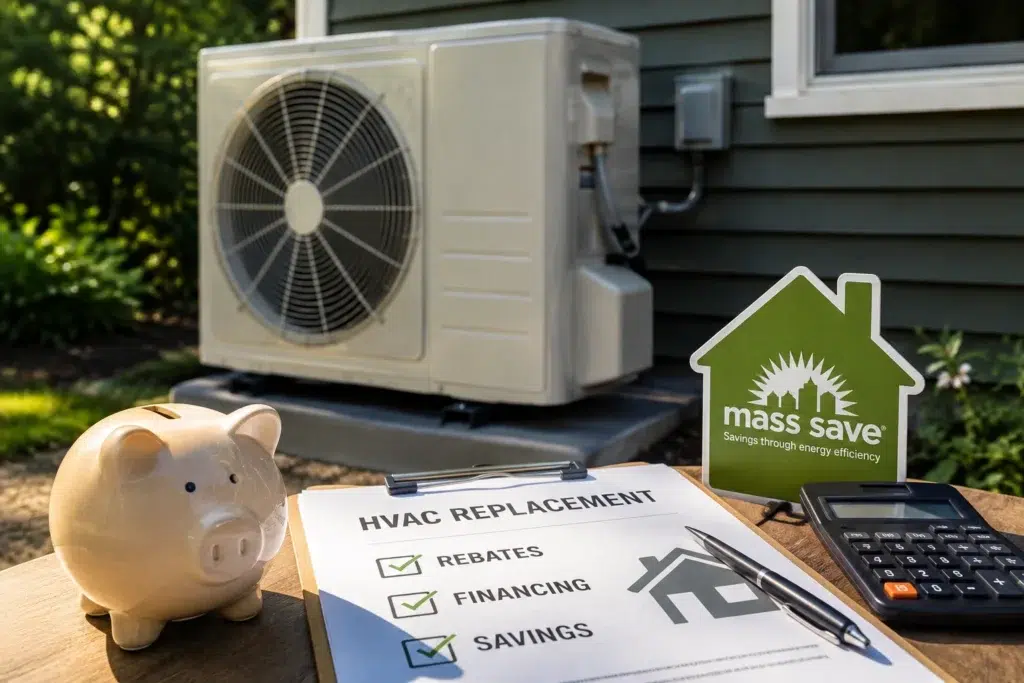
- They qualify for substantial Mass Save rebates of up to $8,500 per home for whole home heat pump installations, plus a 0% HEAT Loan of up to $25,000 over seven years for qualifying projects.
- They deliver zone level control, so you’re not cooling rooms no one is using.
- Modern cold climate models maintain full capacity to around 5°F and continue to operate at lower output well below zero, viable as primary heating in New England.
We install both central systems and ductless mini splits across eastern Massachusetts, and the right answer depends on your home. A ranch with original ducts that are leaking and undersized is a strong mini split candidate. A larger home where the existing ductwork is in good condition and the old central unit is simply at end of life is usually a central replacement job. A proper load calculation and duct assessment takes the guesswork out of it.
|
Not sure which direction makes sense for your home? Book a free AC or mini split consultation between April 18 and June 1 and you’ll be entered to win two basketball championship tickets. Visit goendlessenergy.com to schedule. |
When Repair Still Makes Clear Sense
None of this is a push toward replacement for every homeowner. Plenty of situations point cleanly to repair:
- A system under 10 years old with a single failed component (capacitor, fan motor, contactor) should almost always be repaired.
- A well maintained 12 to 14 year old system on R-410A with no prior repair history is usually worth fixing for anything under $1,000 to $1,200.
- Homeowners planning to sell within the next one to two years often don’t recoup replacement cost at sale, making a reasonable repair the smarter near term play.
- Emergency repairs in the middle of a heat wave can make sense even on aging systems. Finish the summer, then plan replacement for the off season when pricing and scheduling work in your favor.
The goal isn’t to sell equipment. The goal is a clear picture so you can make a decision you won’t regret when August hits and the system is running flat out.
Getting Ahead of It Before the Season Starts
The best time to have this conversation is before a breakdown forces your hand.
A preseason AC tune up gives a technician the chance to assess overall condition, check refrigerant levels, measure electrical draw, and flag components that are showing signs of wear. That information puts you in a position to plan: schedule a repair now while parts are available, get a replacement quote while installers have capacity, or head into summer confident the system is tight.
The worst version of this decision is the one made at 4pm on a 95 degree Saturday, when lead times are long and every option feels urgent.
Why Metrowest and South Shore Homeowners Work with Endless Energy
A few things we bring to every repair versus replace conversation:
- Mass Save qualified installer. We handle the rebate paperwork so you don’t have to.
- Both ductless and central expertise. We recommend the right system for your home, not the easiest one to install.
- Transparent pricing on both sides of the decision. You’ll see the repair number and the replacement number before you commit.
- Manual J load calculations on every replacement quote. No eyeballing tonnage from the old nameplate.
- Local service across Metrowest, the South Shore, and eastern Massachusetts. We know the housing stock and what works in these homes.
AC Repair vs. Replace: Frequently Asked Questions
How do I know if my air conditioner needs to be replaced or just repaired?
The three main factors are the age of your system, the cost of the AC repair relative to replacement cost, and the frequency of past repairs. A system over 15 years old that requires a costly repair is usually a better candidate for replacement than continued patching.
What is the 50 percent rule for AC replacement?
The 50% rule says that if a repair costs more than half the price of a new system, replacement is typically the more financially sound decision, especially when the system is aging. It’s a useful anchor, and it works best alongside a full picture of repair history and system age.
Is R-22 refrigerant still available in Massachusetts?
R-22 has not been produced in the U.S. since 2020, but recovered and recycled refrigerant is still available. Prices have risen substantially and long term availability is uncertain. Systems running on R-22 with active leaks are strong candidates for replacement rather than repeated recharging.
How long does an AC replacement take in Massachusetts?
Most straightforward central AC replacements are a one day job. Mini split installations generally run one to two days for multi zone systems. Larger projects with electrical upgrades or ductwork modifications can take two to three days.
What Mass Save rebates are available for AC or heat pump replacement?
Mass Save rebates for whole home heat pump installations currently reach up to $10,000, plus a 0% HEAT Loan of up to $50,000 over seven years for qualifying projects. Program specifics change periodically, so confirm current rebate levels with your installer before committing to a system.
Do mini splits work in cold Massachusetts winters?
Modern cold climate heat pumps maintain full heating capacity down to roughly 5°F and continue to operate at reduced output well below zero. Paired with a backup heat source where needed, they work as primary heating across New England.
How much can I save on energy costs by replacing an old AC unit?
Moving from an older low efficiency unit (roughly 10 SEER) to a modern high efficiency system (18 to 20 SEER) can cut cooling costs by 40 to 50%, depending on how heavily you run the system and how large the efficiency gap is. Over a full Massachusetts cooling season, that translates to meaningful dollar savings.
Should I repair my AC now or wait to replace it in the off season?
If the repair is minor and buys you reliable cooling through the summer, finishing the season and scheduling replacement for fall or early spring is often the smartest play. Off season installs usually have shorter lead times and more scheduling flexibility.
What’s the best time of year to replace an AC in Massachusetts?
Shoulder seasons (April through early May and October through November) generally offer the best combination of installer availability and planning time. Mid summer replacements are possible, but they involve longer lead times when contractors are at capacity.
Get Both Numbers Before Summer Hits
A free consultation with an Endless Energy technician gets you both numbers (repair cost and replacement cost) side by side, plus a clear read on the overall condition of your system. Plus book your AC Consultation between April 18 and June 1 and you’re entered to win two basketball championship tickets.
Self-schedule your AC repair or AC replacement consultation at goendlessenergy.com.