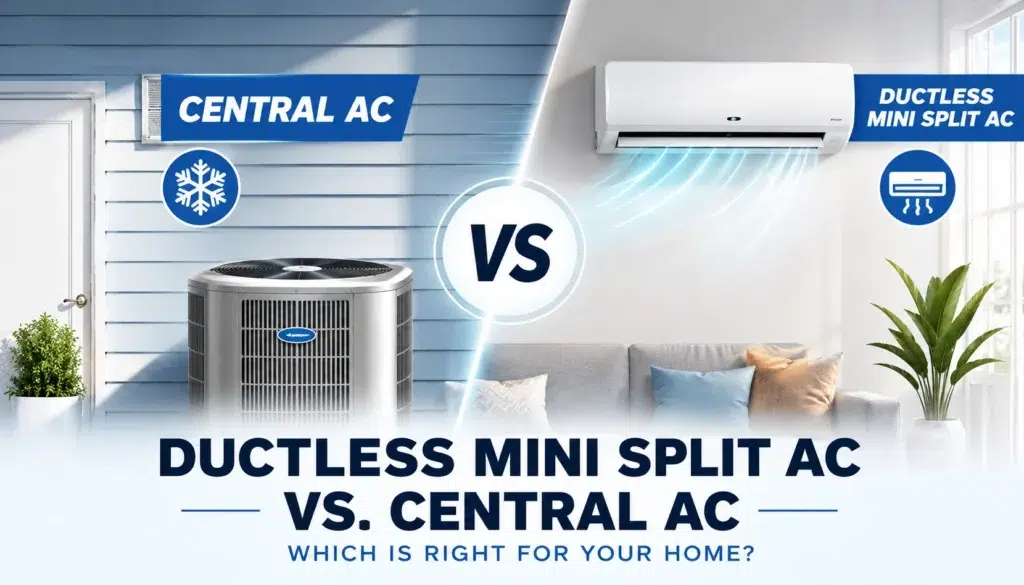
When you’re deciding between ductless mini split vs central AC, the right answer depends on your home and your comfort goals.
In the middle of July in Massachusetts, does your upstairs feel like a tropical climate? Between rising electricity costs and summer humidity, a lot of homes on the East Coast start to show their weak spots. It’s especially noticeable in older homes without ductwork or with leaky ducts. This is when a lot of people start weighing mini split vs central AC. The best answer depends on your house — what’s already built in, where the problem areas are, and how you live in the space.
Table of Contents
ToggleWhat Is a Ductless Mini Split System?
A ductless mini split is a heating and cooling system that operates with an outdoor compressor and one or more indoor units. They use heat pump technology and offer high efficiency when installed correctly.Best use cases
- Homes without existing ductwork
- Additions, finished basements, or attics
- Rooms that are consistently too hot or too cold
- Homeowners who want room-by-room temperature control
What Is Central Air Conditioning?
Central air conditioning uses a single system to evenly cool your entire home through ductwork. A central unit pushes conditioned air through vents, typically controlled by a single thermostat.Best use cases
- Homes with existing duct systems in good condition
- Larger homes that benefit from uniform airflow
- Homeowners who prefer a single, consistent temperature
Mini Split vs Central AC: Key Differences
The core differences in central AC vs ductless pros and cons come down to installation, efficiency, and control. Here’s how they compare:Mini split
- There’s no ductwork needed, which can make installation costs less expensive.
- Energy efficiency is high and there’s no duct loss.
- Cooling is targeted and zone-based by design.
- Zoning is built in so you don’t need extra equipment.
- Maintenance means filter cleaning and annual service.
- Lifespan: 15–20 years.
Central AC
- The installation cost is lower if ducts exist, but much higher if they don’t.
- Energy efficiency is lower due to duct leakage.
- This type of system gives you whole-home coverage.
- Zoning requires extra equipment.
- Maintenance includes duct inspection plus standard service.
- Lifespan: 15–20 years.
Energy Efficiency & Operating Costs in Massachusetts
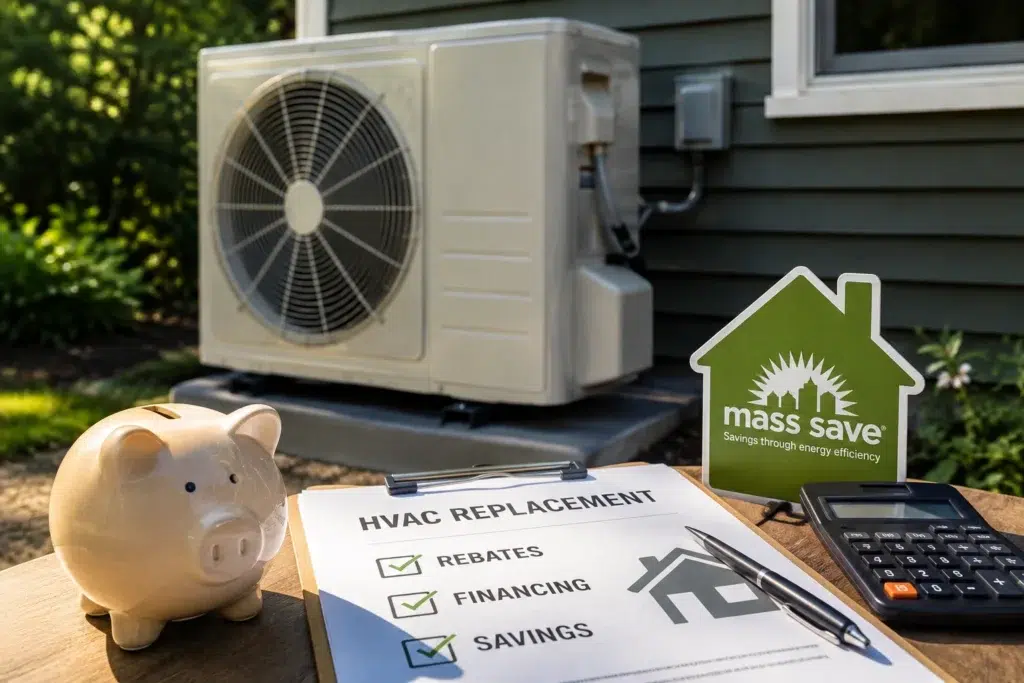
When you’re evaluating mini split vs central air Massachusetts, one of the deciding factors can be operating costs. Electricity rates in Massachusetts are among the highest in the country, so the energy efficiency of your cooling unit directly impacts your monthly bill. When you’re looking at the differences in these two systems, remember to factor in incentives which can reduce upfront costs. As a Massachusetts homeowner, you might qualify for substantial rebates through the Mass Save® program. Check out our offers, too.Installation Considerations
Mini split installation
Installing a mini split system is fairly fast — most are installed in one or two days. A small opening connects the indoor and outdoor units, without a need for ductwork. For homeowners considering mini split installation MA, this is often the least disruptive way to upgrade comfort, especially in older homes.Central AC installation
Central air conditioning installation is straightforward if ductwork already exists and it’s in good condition. But in homes without ducts, installation can become a lot more complicated. Adding or fixing ductwork might mean opening walls, ceilings, and floors. This increases labor and material costs. If you’re thinking about central air installation in Massachusetts, the condition and layout of your ducts will influence the cost and amount of disruption.Comfort & performance differences
The choice comes down to precision versus consistency. Mini splits are great for targeting rooms where each zone operates independently so you can customize temperatures per area. They also tend to manage humidity more effectively. Central AC provides consistent, even cooling. If you’ve got a house with ducts that don’t leak, central AC gives every room airflow without visible components.Pros and Cons of Each System
Mini split pros
- High energy efficiency
- Zoned temperature control
- Ideal for older homes without ducts
- No energy loss through ductwork
Mini split cons
- Higher upfront cost for multi-zone systems
- Visible indoor units
Central AC pros
- Whole-home cooling from a single system
- Lower cost when ductwork already exists
- Clean, hidden appearance
Central AC cons
- Energy loss through ducts
- Limited flexibility for individual rooms
- Higher installation cost in homes without ducts
Which System Is Best for Massachusetts Homes?
So, is a mini split better than central air? When it comes to finding the best cooling system for Massachusetts homes, the decision is less about the system and more about your home. In older homes without ducts, mini splits are often the better fit. They’re great for additions or hard to cool spaces. In homes with existing ductwork, central AC remains a strong option. If you have mixed needs, hybrid systems can offer the best of both.Cost Comparison: Mini Split vs Central AC
When you’re comparing ductless mini split vs central AC costs:- Mini split systems can cost around $4,000–$15,000+, depending on the number of zones you need.
- Central AC systems can cost around $6,000–$12,000+ when ducts already exist. If extra ductwork is needed, central AC costs can climb fast, sometimes higher than $15,000.
Why More Massachusetts Homeowners Are Choosing Mini Splits
There’s a shift toward mini splits here in Massachusetts because they tend to be more energy efficient and there are often strong rebate programs through Mass Save®. More and more, homeowners here choose mini splits because they solve comfort issues without requiring major structural changes.Why Choose Endless Energy for Your Cooling System
Choosing between systems is only part of the process. You should look for trusted, professional evaluation, proper design, quality installation, and long-term support. Endless Energy stands out with:- Mini splits and central AC system experience.
- A history in serving Massachusetts homeowners.
- 5-star customer reviews showcasing reliability, clear communication, and quality workmanship.
- Certified, trained technicians with the latest industry knowledge.
- Guidance on Mass Save® rebates and energy efficiency programs.
- Flexible financing options.
- Customized system recommendations based on your home.