
Is Your AC Ready for Summer? Here’s What to Check Before You Turn It On
How do you prepare your AC for summer? Most people find out their AC isn’t working on the first hot day of the year. The system sits untouched all winter, sometimes all spring too, and the first real test comes when it’s 88 degrees and the house is already uncomfortable. That’s not when you want to discover a problem.
The good news is that most summer AC failures aren’t random. They’re predictable. And a lot of them can be caught before they happen if you take a little time in April or early May, before the heat actually arrives.
This isn’t a complicated process. Some of it you can do yourself in about 20 minutes. Some of it is worth having a technician handle before the season starts. Here’s how to think through it.
Table of Contents
ToggleStart Outside: How to Inspect Your Condenser Unit
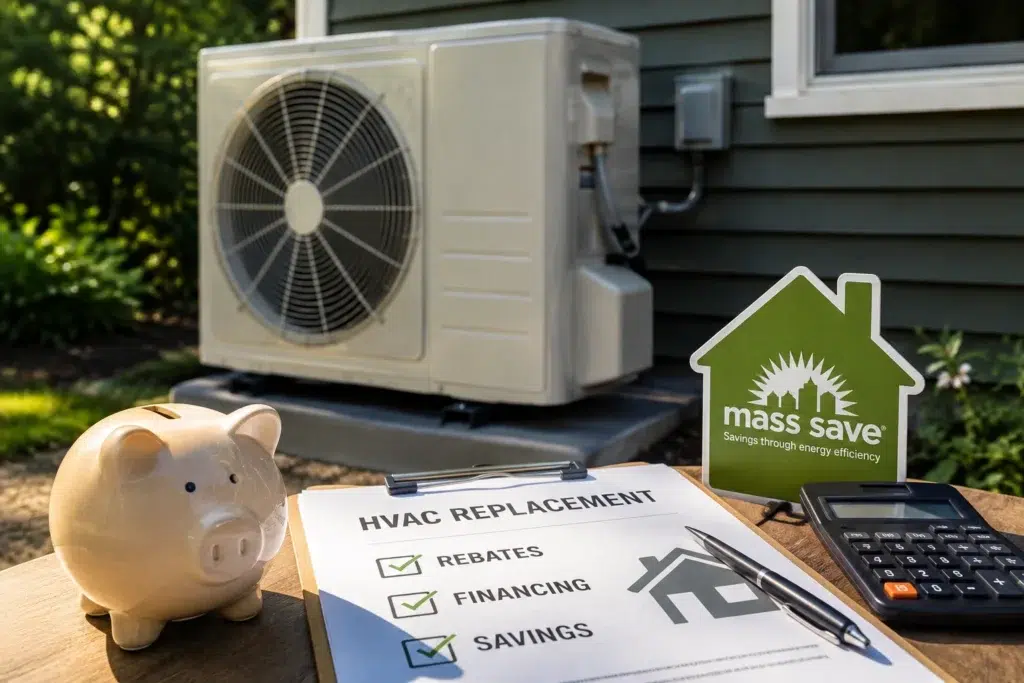
The outdoor unit, the big metal box that sits on a pad beside your house, takes a beating over a New England winter. Snow, ice, debris, and months of sitting idle can all create problems that aren’t obvious until the system tries to run.
Walk out and take a look before you do anything else. Clear away any leaves, sticks, or debris that built up around the unit over the fall and winter. You want at least two feet of clearance on all sides for the system to breathe properly. If you threw a cover over it last fall, pull that off now. Running the system with a cover on is one of the more common early-season mistakes we see.
Check the fins on the sides of the unit. Those are the thin metal slats that allow heat to exchange through the coil. If they’re bent or crushed in spots, airflow gets restricted and the system has to work harder to do its job. Bent fins can be carefully straightened with a fin comb, though if significant sections are damaged it’s worth mentioning to a technician.
Look at the refrigerant lines, which are the insulated copper pipes running from the unit into the house. The insulation should be intact. If it’s cracked, falling off, or missing in sections, that’s something to address. Degraded line insulation affects system efficiency and can let moisture into places it shouldn’t be.
Also make sure the unit itself is still level on its pad. Frost heave and freeze-thaw cycles can shift concrete pads over the winter in Massachusetts. A unit that’s noticeably out of level can cause compressor problems over time.
Replace Your Air Filter Before the First Run
This is the single most common reason Endless Energy’s HVAC service techs find AC systems underperforming in the spring. A filter that sat through a heating season without being changed is often clogged enough to seriously restrict airflow through the system.
A dirty filter makes everything harder. The system has to pull harder to move air, which stresses the blower motor and can cause the evaporator coil inside the air handler to ice over. Frozen coils mean the system blows air but doesn’t cool anything, which leads to the exact call we get constantly every June: “my AC is running but the house isn’t getting cold.”
Pull the filter out and look at it. If it’s gray and you can’t see light through it, it needs to go. Put in a new one before the first time you run the system this season. If you’re on a one-inch filter, those need to go every one to three months depending on how dusty your home is. If you’ve got a thicker media filter or an air purifier setup, those last longer but still need attention.
Clear Your Condensate Drain Line (Skip This, Risk Water Damage)
This one gets overlooked every year and causes water damage that surprises homeowners. The condensate drain is the pipe that carries moisture removed from the air during cooling. Over the winter it can develop algae, mold, or debris buildup that creates a blockage.
When the drain line clogs, the drip pan under the air handler fills up and eventually overflows. Depending on where your air handler is, that can mean water on a basement floor, water staining a ceiling if the unit is in an attic or second-floor closet, or water damaging walls near the unit.
You can flush a condensate line yourself by finding the access point, usually a PVC pipe with a cap near the air handler, and slowly pouring a cup of distilled white vinegar down it. Let it sit for 30 minutes, then flush with water. Some homeowners do this every spring and fall as a routine. If your line has a float switch, test that it’s working by tilting the drip pan slightly to see if the system shuts off when water rises.
Check Your Thermostat
Before you run the system the first time, switch your thermostat to cool and set it five degrees below the current room temperature. Wait a few minutes and listen for the outdoor unit to kick on. You should hear it start up and feel cooler air coming through the registers within about ten minutes.
If the HVAC system doesn’t respond, start simple. Check that the breaker for the outdoor unit hasn’t tripped over the winter. There’s usually a disconnect box directly beside the outdoor unit as well as a breaker inside your electrical panel. Both need to be on.
If you have a smart thermostat, check that it updated its programming after any power outages over the winter. Thermostats that revert to a default schedule can cause the system to behave unexpectedly at the start of the season.
If the system starts but the air coming out of the registers isn’t noticeably cool after fifteen minutes of running, that points to a refrigerant issue or a coil problem, both of which need a technician.
Inspect Your Vents and Registers
Walk through the house and make sure supply registers are open and clear. It’s common to find registers that got closed off in bedrooms over the winter, or that have furniture pushed in front of them. Closing too many registers creates pressure imbalances in the duct system and stresses the equipment.
Take note if any rooms feel like they’ve had poor airflow for a while. Rooms that never quite cooled properly last summer, or that always felt warmer than the rest of the house, are worth mentioning when a technician comes out. Sometimes it’s a duct issue, a damper that needs adjustment, or a balancing problem. Sometimes it points to something else. Either way, it’s useful information.
Check your return air grilles too, the larger vents that pull air back to the system rather than delivering it. These should never have anything blocking them, and they should be clean enough to allow airflow. Pull the grille off and look at what’s behind it. If there’s significant dust buildup on the return side, that’s restricting how much air the system can pull.
What to Watch for on the First AC Run of the Season
The first time you turn on the AC after a long off-season, it’s worth being home and paying attention to it. Give it a full 30-minute run and notice a few things: does the outdoor unit start without any grinding, squealing, or rattling? Does airflow feel consistent at registers throughout the house? Is the system actually dropping the temperature?
A system that starts normally, moves air well, and cools the house is doing its job. A system that starts and then short-cycles, meaning it turns on and off frequently without holding a run, may have a refrigerant charge issue, an oversizing problem, or a failing component.
Some refrigerant odor the first time a system runs after a long idle period isn’t unusual. A persistent burning smell is not normal and means something is wrong, either electrically or mechanically.
When to Schedule an AC Tune-Up Before Summer
If your system is more than ten years old and hasn’t had professional AC maintenance in a year or more, it’s worth scheduling a tune-up before you actually need cooling. Our technicians check refrigerant levels, inspect electrical connections and contacts, clean the evaporator and condenser coils, test capacitors and contactors, check the blower motor and belt if applicable, and verify system pressures and airflow.
That kind of proactive visit catches problems that aren’t obvious from the outside. Failing capacitors, for example, don’t look like anything until the system refuses to start on a hot day. Low refrigerant doesn’t announce itself until the system can’t keep up. These are things that show up on gauges and in inspections, not in a visual walkthrough.
If your system is 15 years or older and has needed AC repairs in the last couple of seasons, it’s also worth having an honest conversation about AC replacement before summer arrives. Running an aging system into another hot season while hoping it holds together is a reasonable choice sometimes, but going into it with accurate information about what failure might look like and what a replacement would cost is better than being surprised in July.
What Endless Energy Does at the Start of the Season
We serve more than 160 towns across Massachusetts, with offices in Marlborough, Needham, and Randolph. Our technicians do spring AC tune-ups throughout April and May, before the demand surge that happens every June.
Scheduling earlier in the spring typically means more flexibility with appointment times and less waiting.
If you’ve got an older system that’s been reliable but is getting toward the end of its life, or if you had issues last summer that you never fully sorted out, this is the right time to get a technician out before you’re depending on the system every day.
You can reach us to schedule a tune-up or free AC replacement assessment at any of our three locations. We handle everything in-house, no subcontractors, which means the same standards and accountability on every job.
Starting Your AC for the Summer FAQs
Q: When should I turn on my AC for the first time in Massachusetts?
A: Most homeowners in Massachusetts start running their AC between late May and mid-June, but it’s worth testing the system earlier, in April or early May, so you have time to address any problems before the heat arrives.
Q: What do I check before turning on AC for the first time?
A: Clear debris from the outdoor condenser unit, replace the air filter, flush the condensate drain line, check that the thermostat is set to cool, and verify the breaker and disconnect switch are on. Then run the system for 30 minutes and listen for anything unusual.
Q: Why is my AC not cooling after sitting all winter?
A: Common causes include a clogged air filter, a frozen evaporator coil, a tripped breaker, low refrigerant from a slow leak over the winter, or a failed capacitor. Start with the filter and breaker, and if those check out, call a technician.
Q: How often should I get my AC tuned up in Massachusetts?
A: Once a year is the standard recommendation. Scheduling it in the spring before the cooling season starts is the most practical timing.
Q: Does Endless Energy do AC tune-ups?
A: Yes. We do spring AC maintenance and tune-ups across 160+ towns in Massachusetts. Our technicians check refrigerant levels, clean coils, inspect electrical components, and verify system operation from our offices in Marlborough, Needham, and Randolph.