What Massachusetts Homeowners Should Check Before Temperatures Drop
It may feel too early to think about heating systems, but August is actually a good time to find out whether your boiler is ready for another winter or not.
Why now? Because the worst time to discover a boiler problem is the first 35-degree morning when everyone else in your area is discovering one, too.
Before heating season begins, give your boiler a test run and spend 15 minutes checking the system around your home. You don’t need to take anything apart or know much about boilers. You’re simply looking for signs that something has changed since last winter.
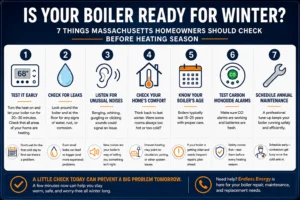
Here are seven things worth checking—and what they can tell you about your heating system.
Turn the Heat On Before You Actually Need It
Don’t make the first cold day of fall your boiler’s first test.
Pick a cooler morning or evening, set your thermostat several degrees above the current indoor temperature, and let the heating system run for 20–30 minutes. Then walk through the house.
You’re checking for a few basic things:
- Did the boiler start without repeatedly trying to fire?
- Are your radiators or baseboards getting warm?
- Is heat reaching every room?
- Did you hear any noises you don’t remember from last winter?
- Did the thermostat reach the temperature you selected?
One cold radiator or baseboard doesn’t necessarily mean your boiler is failing. Air in the system, a zone valve problem, circulation issues, or a thermostat problem can all cause uneven heating.
What you don’t want to do is wait until November to discover that the second floor hasn’t been heating properly since last season.
Call a professional if: the boiler won’t start, repeatedly starts and stops, a heating zone doesn’t work, or the system runs but parts of your home stay cold.
Look Around the Boiler—Especially at the Floor
You don’t have to remove the boiler cover to spot some of the earliest signs of trouble.
Look at the boiler, the visible piping around it, and the floor underneath. Everything should be dry.
A small amount of water around a boiler can be easy to dismiss, especially in an unfinished Massachusetts basement. But recurring moisture can point to a leaking valve, connection, pump, pressure issue, or another component that needs attention.
Also look for:
- Rust or corrosion that wasn’t there before
- Mineral deposits around pipe connections
- Water stains below the boiler or nearby piping
- Dripping or pooling water
- Dampness that returns after being wiped up
Take a photo if you’re unsure. Check the same area again after your boiler has completed a heating cycle. That can help you determine whether you’re looking at an old stain or an active leak.
Listen to It
Boilers aren’t silent. Pumps run, pipes expand and water moves through the system, so an occasional click or subtle sound isn’t automatically a problem.
What matters is whether the boiler sounds different from what you’re used to hearing.
Pay attention to new:
- Banging or knocking
- Whistling
- Gurgling
- Rumbling
- Grinding
- Repeated clicking as the boiler tries to start
Different noises can have very different causes. For example, gurgling may indicate air trapped in the system, while banging can be associated with circulation or pressure problems.
The sound itself usually isn’t enough to diagnose the issue, so resist the urge to start adjusting valves or boiler controls based on a video you found online. Instead, record the sound on your phone. A short video can be surprisingly helpful when you call for service—especially if the noise doesn’t happen constantly.
Think Back to Last Winter: Were Some Rooms Always Too Hot or Too Cold?
One of the easiest boiler problems to overlook isn’t in the basement at all. Think about how your home actually felt last winter.
Was your bedroom freezing while the living room was comfortable? Did one floor take much longer to warm up? Were you constantly raising the thermostat because the house never quite felt warm?
Hot-water heating systems are supposed to distribute heat throughout the home. Persistent hot and cold spots can point to issues with circulation, zoning, controls, radiators, baseboards, or the overall balance of the system.
This is especially worth addressing in older Massachusetts homes, where heating systems may have been altered over decades as additions were built, rooms were renovated, or equipment was replaced.
And don’t assume that a colder room automatically means you need a larger boiler. Bigger isn’t always better. The goal is to understand why the heat isn’t reaching that space properly.
Check the Boiler’s Age—Even If It’s Still Working
If you don’t know how old your boiler is, now is a good time to find out.
Check the equipment for a manufacturer’s label or model and serial number. If you can’t determine the age from the label, a heating professional can usually help.
A well-maintained boiler can often last 15–25 years, so age alone isn’t a reason to replace one. But once a boiler gets into that range, its condition becomes increasingly important.
Ask yourself:
- Has it needed repairs in each of the last few winters?
- Are replacement parts becoming difficult or expensive to find?
- Have your heating costs climbed without another obvious explanation?
- Does it struggle to keep the house comfortable on very cold days?
- Are you worried every winter that this will be the year it finally fails?
If several of those sound familiar, don’t wait for the boiler to make the decision for you.
Having an aging system evaluated before winter gives you time to understand the condition of the boiler and compare your options without making a rushed decision during a no-heat emergency.
Make Sure Your Carbon Monoxide Alarms Are Ready
If your boiler burns natural gas, propane, or oil, boiler preparation isn’t only about comfort—it’s also about safety.
Massachusetts requires homes with fossil-fuel-burning equipment to have approved carbon monoxide alarms. Before heating season, test the CO alarms in your home and replace batteries or expired alarms as necessary.
You should never try to diagnose a suspected combustion or venting problem yourself.
If a carbon monoxide alarm sounds, follow the alarm manufacturer’s emergency instructions and get everyone to fresh air. If you smell gas or suspect a gas leak, leave the home and contact emergency services from outside.
This is one part of boiler maintenance where “wait and see” isn’t appropriate.
Schedule Maintenance Before the First Cold Snap
One of the top reasons boilers break down in the winter is lack of maintenance in the months prior to the big temperature drops across Massachusetts. Even if your 20-minute test goes perfectly, it doesn’t replace professional boiler maintenance.
Mass Save recommends that boilers be professionally serviced every heating season. Depending on your system, a technician may inspect components for corrosion or leaks, check combustion and safety controls, examine venting, clean components, and identify wear that isn’t visible from the outside.
Scheduling that service before winter has another practical advantage: time.
If a technician finds a worn component in August or September, you have an opportunity to address it before you depend on the boiler every day. If an older boiler is nearing the end of its useful life, you have time to compare repair and replacement options rather than choosing whatever can restore your heat fastest.