Table of Contents
ToggleWhat’s making it more expensive to heat homes in the northeast
Every oil-heated house in New England knows the routine. The oil truck pulls into the driveway sometime in mid to late fall, the driver runs the hose to the fill pipe, and a few days later an invoice shows up that makes you wince a little harder than it did last year.
This winter, that invoice is projected to be a lot bigger.
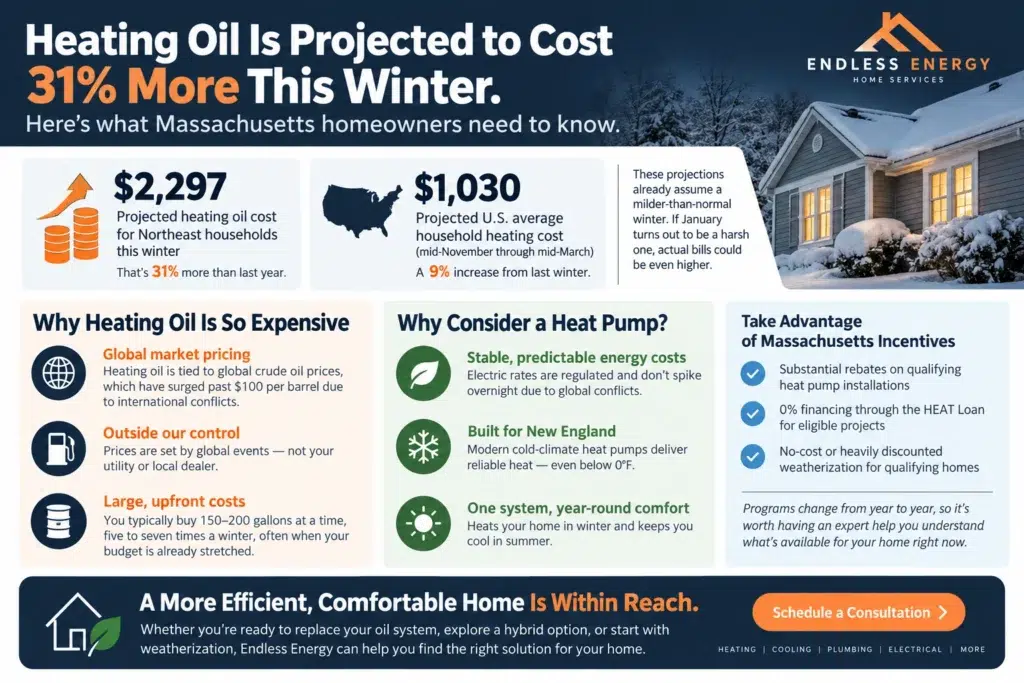
The National Energy Assistance Directors Association (NEADA) projects that the average U.S. household will spend about $1,030 on heating from mid-November through mid-March, roughly 9%, more than last winter.
Northeast households specifically: about $2,297 for heating oil
Two things make the Northeast oil more expensive to heat our homes with. Our winters are longer, and here’s the part worth sitting with: these projections already assume a milder-than-normal winter thanks to El Niño.. If January turns out to be a brutal one, the actual bills will land higher than these numbers.
Why oil, specifically, is getting expensive
Heating oil isn’t priced by your utility or your local dealer in any meaningful sense. It’s priced by the global crude market, and that market has been ugly.
Before the recent U.S.and Iran conflict, crude oil traded around $72.00 a barrel. With shipping through the Strait of Hormuz constrained, it has pushed past $100.00 a barrel. Wholesale heating oil prices follow crude, and retail prices follow wholesale.
This is the problem with heating a house on oil. Your comfort is tied to a globally traded commodity whose price is set by events entirely outside your control, and outside your dealer’s control, too.
You don’t pay for oil a little at a time. You pay for 150 to 200 gallons at once, five to seven times a winter, often at the exact moments your budget is most stretched.
Why you may want to consider switching from oil to a heat pump:
A furnace or boiler makes heat by burning fuel. A heat pump doesn’t make heat. It moves heat, pulling thermal energy out of outdoor air and concentrating it indoors. Because moving energy takes far less work than creating it, a modern cold-climate heat pump routinely delivers two to four units of heat for every unit of electricity it consumes. That’s not a marketing claim; it’s why the technology is displacing combustion across the region.
You stop buying a commodity with a war premium.
Electric rates in Massachusetts are high. Nobody at Endless Energy is going to tell you otherwise, but they’re set through a regulated process, they move in scheduled steps, and they don’t reprice overnight because of a shipping lane in the Persian Gulf.
Today’s cold-climate units are genuinely built for New England.
The heat pump your neighbor complained about in 1998 has almost nothing in common with the heat pumps we install now. Properly specified cold-climate air source heat pumps produce rated heating capacity well below 0°F. The engineering problem was solved; the reputation just hasn’t caught up.
One system, both seasons.
The same equipment that heats you in February cools you in July. Homeowners replacing an oil boiler and aging window units or a tired central AC are effectively solving two capital projects at once.
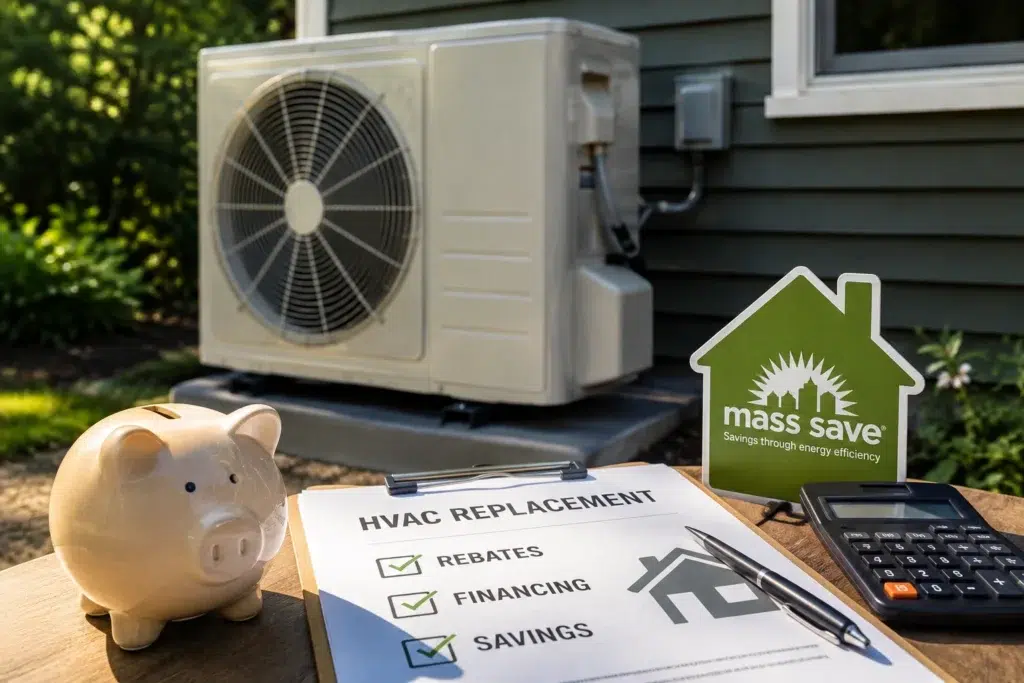
Add the incentives. Massachusetts is among the most aggressive states in the country for residential electrification with substantial rebates on qualifying heat pump installations, 0% financing through the HEAT Loan for eligible projects, and no-cost or heavily discounted weatherization for qualifying homes. The programs shift from year to year, which is exactly why it’s worth having someone walk you through what’s available for your house right now.
Additional Considerations
- A heat pump is not automatically cheaper to run than oil in every house. The math depends on four things: how leaky your house is, how the system is sized, what rate you’re on, and what you’re replacing. Put a beautifully specified heat pump in a house with an uninsulated attic and a 1940s sill, and you’ll be disappointed. The same way you’d be disappointed with any heating system in that house.
- That’s why sequence matters. Air sealing and insulation reduce the load first, which means smaller equipment, lower operating costs, and a more comfortable house regardless of what’s making the heat. Weatherization is the least glamorous and highest-returning thing most New England homeowners can do.
- And you don’t have to go all-or-nothing. A hybrid setup is a heat pump doing the great majority of the annual heating, with your existing boiler retained as backup for the handful of truly severe days. This is a legitimate path for a lot of homes in New England, and we install those too!
What Working with Endless Energy Looks Like
We’ve been a Massachusetts privately owned company since 1980. We specialize in HVAC, plumbing, electrical, and weatherization under one roof, which matters more than it sounds like it should — an oil-to-heat-pump conversion usually touches all four. We’ll assess the house, run the load calculation, show you real numbers for the options that actually fit. We handle the incentive paperwork, and do the electrical work without subcontracting it to a stranger. In addition we provide all eligible rebates instantly upfront, so you do not have to wait months for a rebate check in the mail! Interested in learning, you can self schedule a no cost HVAC consult directly on our website.
FAQs
Will a heat pump actually keep my house warm in a New England winter?
Yes, when it’s properly specified and installed. Cold-climate air source heat pumps are designed and rated to deliver heat well below 0°F, and they’re now the primary heat source in tens of thousands of Massachusetts homes. The failures you hear about almost always trace back to undersized equipment, a house that was never air-sealed, or a unit that wasn’t a cold-climate model to begin with.
Won’t my electric bill go up?
Your electric bill will possibly increase.. You’re moving a load onto it. The question is whether the increase is smaller than the oil bill it replaces, and in most reasonably tight homes it is. We’ll model both for your house before you commit, using your actual usage history rather than averages.
Can I keep my oil boiler as a backup? Absolutely. Hybrid systems are common and a good fit for larger or older homes, homes with existing hydronic distribution, and homeowners who want a season or two of overlap before fully committing.
What happens to my oil tank?
It can stay, be decommissioned, or be removed, depending on whether you’re going hybrid and where the tank sits.
How long does an installation take?
Most whole-home conversions run one to four days of on-site work depending on the distribution approach and electrical requirements.
What rebates and financing are available?
Massachusetts offers some of the strongest residential incentives in the country, including rebates on qualifying heat pump installations, 0% HEAT Loan financing for eligible projects, and no-cost or reduced-cost weatherization for qualifying households. Amounts and eligibility rules change, so we’ll confirm what applies to your home at the time of your consultation.
Do I need ductwork?
Duct work is not required, so this is a personal choice!. Ducted, ductless, and mixed systems all work. Ductless mini-splits are often the cleanest solution for homes with hydronic baseboard or radiators and no existing duct runs.
Is it worth doing if I might sell in a few years?
Electrified, well-insulated homes are increasingly what Massachusetts buyers are looking for, and a heat pump also delivers central cooling — a feature that shows up in listings. It’s worth weighing against your specific timeline, which we’re happy to talk through honestly.
*Cost projections cited are from the National Energy Assistance Directors Association (NEADA) for the mid-November through mid-March 2026 heating season.